
South Korea's HD Hyundai Heavy Industries and US firm Anduril Industries launched the 600-ton ASV Alpha at Ulsan on November 12. Sea trials off Korea come first, then testing in the United States in early 2027.
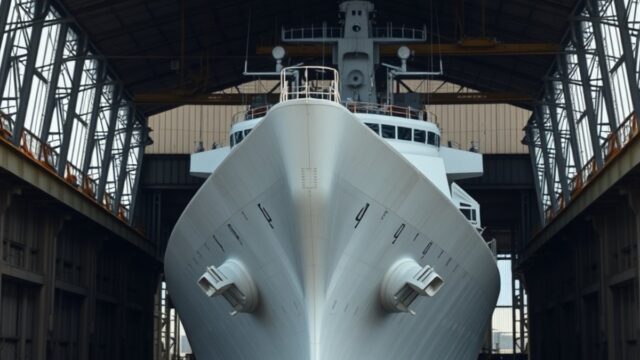
South Korea's HD Hyundai Heavy Industries (HHI) and US company Anduril Industries have launched the ASV Alpha autonomous vessel, a 600-ton uncrewed surface ship, at HD HHI's shipyard in Ulsan, South Korea. HD HHI announced on November 15 that the launching ceremony took place on November 12.
Key specifications
- Vessel ASV Alpha, 600-ton autonomous surface vessel
- Builders HD HHI and Anduril Industries
- Launch November 12, Ulsan, South Korea
- Build time About 12 months after contract signing
- Software VAone and Anduril Lattice
- Next Sea trials off Ulsan, US testing early 2027
The companies built the vessel in about 12 months after signing the contract, according to Naval News. HD Hyundai's Naval Ship Division contrasted that with the roughly nine years it said a conventional crewed warship needs from concept to launch. Naval Technology reported that representatives of both companies, the US military and the US Embassy in Seoul attended.
The vessel is meant to compete for upcoming US Navy uncrewed-vessel requirements. The Navy announced plans to procure 30 medium-sized autonomous surface vessels, and the companies are targeting that demand.
Design and autonomy software on ASV Alpha
ASV Alpha has no crew accommodations or life-support spaces, which frees internal volume for fuel and mission payloads, according to the reports. Its hull uses modular mission containers that operators can swap to change missile and sensor packages for reconnaissance, surveillance and maritime intelligence missions.
Two autonomy systems are integrated. VAone, developed by HD Korea Shipbuilding & Offshore Engineering, handles autonomous navigation, machinery monitoring and automated damage response, and is built on Avikus's HiNAS Prime navigation suite, Naval News reported. Anduril's Lattice platform governs mission planning, tactical coordination and payload autonomy.
Next steps for the HD HHI and Anduril vessel
HD HHI plans initial sea trials off Ulsan, then deployment to the United States in early 2027 for further testing and collection of operational data.
The launch follows a joint demonstration in October off the Port of Long Beach, California, using a modified 368-ton former US Navy test vessel. According to Naval News, the companies validated the combined VAone and Lattice software across formation sailing, dynamic mission changes and simulated machinery failures.
Naval Technology said the launch came a year after the two firms announced a partnership to design and build dual-use autonomous vessels. One variant is intended to meet the requirements of the US Navy's Modular Attack Surface Craft (MASC) program.
Frequently asked questions
What is ASV Alpha?
ASV Alpha is a 600-ton autonomous surface vessel launched by HD Hyundai Heavy Industries and Anduril Industries at Ulsan, South Korea, designed to operate without a crew and carry modular mission containers.
When will ASV Alpha be tested in the United States?
HD HHI plans sea trials off Ulsan first, then deployment to the United States in early 2027 for further testing and operational data collection.
Why are HD HHI and Anduril building ASV Alpha?
They aim to compete for US Navy uncrewed-vessel requirements, including the Navy's plan to procure 30 medium-sized autonomous surface vessels.
Sources: Naval News, Naval Technology, Naval Today, MLQ.ai.
AI-assisted: drafted with AI from the sources above and reviewed by an editor.